
When Past Success Leads to Poor Decisions: Dinosaur Anchoring Trap

Lessons from Walmart and ordering inventory in my own business
Dithanon Khrutmuang (O), Founder of Power Ladder
When you place an order with a manufacturer, how do you decide the quantity?
Many businesses start with sales from the same period last year and order a similar quantity. After all, that approach worked before.
But customers, costs, and available cash may have changed. Last year provides a useful starting point. Before confirming an order, we need to check it against conditions today.
I have also held on to methods that worked in my own business. Within the Power Ladder Business Play framework, I call giving past success so much weight that we resist changing a plan Dinosaur Anchoring Trap.

Figure 1. Dinosaur Anchoring Trap: past success keeps us tied to an old plan after conditions change.
A method becomes outdated when it no longer fits the current problem. We may still order the same quantity even though demand has fallen or more cash is needed elsewhere.
Walmart uses an assistant to understand data before deciding
On 18 March 2025, Walmart announced the development of Wally, an artificial intelligence assistant for its merchandising teams. It is designed to help users ask questions in everyday language, analyse company data, and investigate why products sell above or below expectations. Walmart announcement
What interests me is how an assistant can help us ask more than “How much did we sell last year?” We can also ask why sales changed and what the latest data suggests we should adjust.
With Power Ladder Business Play, I want to use that information to compare options through both Opportunity and Financial Readiness. A product may have sales potential, but the business must also be able to afford the purchase commitment.
Playing to Win: revisit strategy when the evidence changes

Figure 2. My photograph of Playing to Win beside a Snowflake plush toy.
Playing to Win, by A.G. Lafley and Roger L. Martin, treats strategy as a set of connected choices, including where to compete and how to win. Roger Martin also explains the need to revisit assumptions as more information becomes available. Book · Roger Martin article
I use the book and Snowflake photograph to connect choosing a plan with checking its evidence. When sales, costs, or cash change, we need to reconsider whether the planned order quantity still makes sense.
When applying Business Play to business data on Snowflake, the questions are practical: What sales potential does each plan cover? How much money must we set aside? Will enough cash remain to keep the business running?
Why Snowflake CoWork?
For a business that already uses Snowflake, CoWork lets executives ask questions in everyday language using the company’s own data and analytical tools. Answers can show the source data and queries, while existing access controls still apply. Snowflake documentation
I see its value in helping us follow a business question through the evidence: if we need to keep more cash, how should the purchase plan change? Business Play supplies the decision criteria; experts still check the analysis before we act.
A higher cash requirement changes the buying plan
The following example uses a historical Belly Thailand case from January–February 2026. The Snowflake CoWork images are simulated screens based on calculated results. They show how financial constraints can change the choice of plan.
With a minimum cash requirement of 2 million baht, the two-batch purchase plan meets the condition. It requires about 1,072,385 baht to be set aside for purchases, leaving 2,019,615 baht of cash under the plan.

Figure 3. At a 2 million baht cash minimum, the two-batch plan meets the case-specific Calculated Ambition criteria.
When the minimum rises to 2.4 million baht, that plan no longer meets the condition. We therefore consider buying only the first batch: setting aside about 557,469 baht and leaving 2,534,531 baht of cash under the plan.

Figure 4. After the cash minimum rises, the calculation proposes buying only the first batch.
Buying less preserves cash but covers less of the forecast sales opportunity. The next batch must be reviewed later.
The first-batch plan meets the 2.4 million baht cash minimum. An expert still needs to assess the sales opportunity it leaves uncovered and the timing of the next purchase.
This is where Dinosaur Anchoring Trap can affect a decision. If we keep the old plan because it once made sense, we may leave less cash than the business now requires.
Historical Belly Thailand case contributors: Dithanon Khrutmuang — Business Play creator and consultant; Khin Thandar Kyaw — Data Scientist.
An equation: how much weight does the old answer carry?
Suppose we ordered 100 units last year, but current data suggests 60. If we still give the old quantity 80% of the weight, the selected order becomes 0.8 × 100 + 0.2 × 60 = 92 units.
We can write this as:
x_decision = a × x_old + (1 − a) × x_current
x_old is the old quantity; x_current is the quantity estimated from current data; a is the weight given to the old quantity, from 0 to 1; and x_decision is the selected order quantity.
The gap between the selected quantity and the quantity suggested by current data is:
Anchoring Gap = a × |x_old − x_current|
Here, the gap is 32 units. More weight on the old plan means less adjustment towards the new evidence. I propose this model to explain that weighting. It is an illustration, not a psychological bias score.
Smart Camel: change the questions before confirming the plan
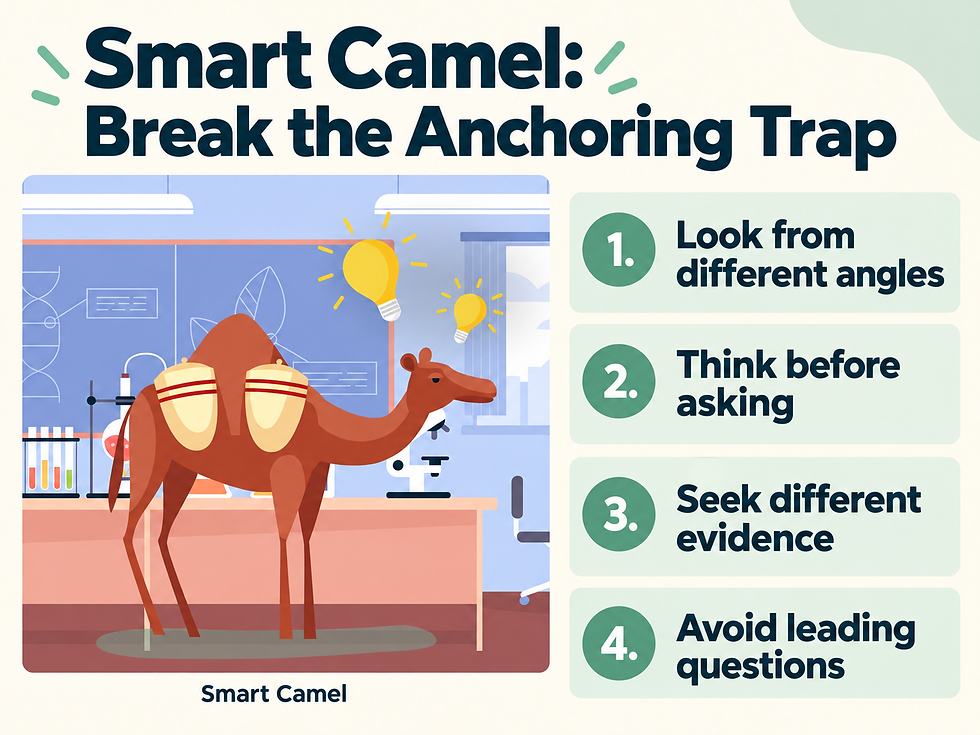
Figure 5. Smart Camel and four ways to review a plan before deciding.
More data helps when we allow it to change the answer. I adapt the guidance on reducing anchoring from The Hidden Traps in Decision-Making to working with an assistant: Original article
View the problem from different perspectives: compare sales potential, remaining cash, and the risk of running out of stock.
Think independently before seeking advice: assess the latest data before opening the old plan or the response from the assistant, so you have your own view to compare.
Seek information from different sources: bring together sales, finance, and inventory data, especially evidence that challenges the old plan.
Avoid leading the assistant: ask “What are the options, and how much cash would each leave?” Allow a comparison before asking for confirmation of a preferred answer.
Then choose a plan that fits both the opportunity and the available cash. Specify which changes in the data will trigger another review.
Before your next order, what would you check to make sure a plan that worked before still fits today?
References
Walmart, 18 March 2025. Walmart Develops GenAI-Powered Assistant for Walmart Merchants
A.G. Lafley and Roger L. Martin. Playing to Win, Harvard Business Review Press
Roger Martin, 20 February 2023. Decoding the Strategy Choice Cascade
Hammond, Keeney, and Raiffa. The Hidden Traps in Decision-Making
Power Ladder, historical Belly Thailand case, January–February 2026.
Snowflake. Snowflake CoWork documentation


Comments